

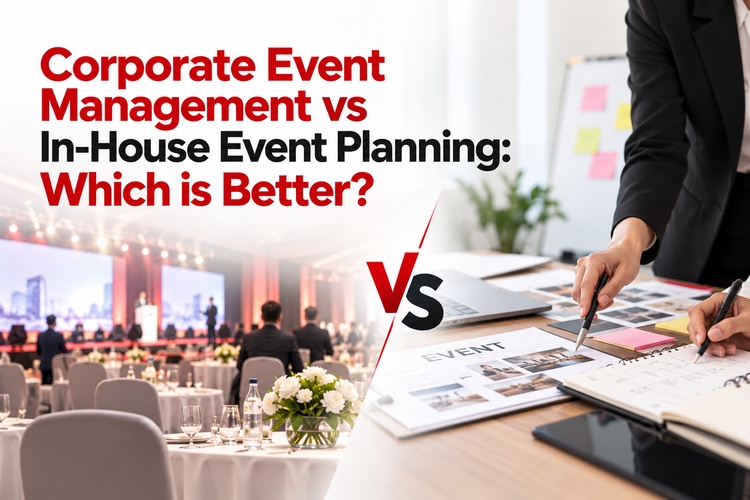
Corporate Event Management vs In-House Event Planning: Which is Better?
Recent Posts



Corporate Event Management vs In-House Event Planning: Which is Better?
Corporate events are no longer limited to meetings, conferences, or annual celebrations. They can include product launches, employee engagement activities, client meets, award functions, exhibitions, and leadership conferences. Each type of event involves several moving parts, including budgeting, venue selection, vendors, guest management, branding, technology, and on-site coordination.
This is why many businesses face an important question: Should we manage the event with our internal team or hire a professional corporate event management company? Both options have their advantages. The right choice depends on the event size, complexity, available resources, budget, and expected results. Let’s compare both approaches to understand which one can work better for your business.
What Is In-House Event Planning?
In-house event planning means the company uses its own employees to organise and manage an event. Usually, HR, marketing, administration, or operations teams take responsibility for planning while continuing with their regular work.
The internal team may handle:
- Budget preparation
- Venue selection
- Invitations and registrations
- Vendor coordination
- Guest management
- Event branding
- Catering
- Scheduling
- On-site arrangements
This approach can work well for smaller events that have straightforward requirements and a limited number of attendees.
What Is Corporate Event Management?
Corporate event management involves hiring an experienced event management company to plan and execute the event. The professional team may take care of everything from initial planning and vendor selection to technical production and event-day execution.
A corporate event management partner can typically assist with:
- Event strategy and concept development
- Venue sourcing
- Vendor management
- Stage and décor setup
- Audio-visual arrangements
- Guest and registration management
- Entertainment and activities
- Transportation and hospitality
- On-ground event coordination
- Post-event evaluation
For larger or more complicated events, professional support can reduce the workload placed on internal employees.
Corporate Event Management vs In-House Event Planning
The biggest difference is who takes responsibility for the planning and execution. Here is a simple comparison:
| Factor | In-House Event Planning | Corporate Event Management |
| Cost Structure | Uses existing employees but requires their time and resources | Involves professional management fees |
| Expertise | Depends on internal experience | Dedicated event professionals |
| Vendor Network | Usually limited to existing contacts | Access to established vendor networks |
| Workload | Added to employees' regular responsibilities | Managed by the event partner |
| Scalability | Better suited to smaller events | Suitable for small to large-scale events |
| Technical Management | Depends on internal capabilities | Specialist technical teams can be arranged |
| Risk Management | Handled internally | Professional teams manage contingencies |
| Creativity | Based on internal ideas and resources | Fresh concepts and professional execution |
| On-Site Coordination | Internal employees manage operations | Dedicated event staff handle execution |
Advantages of In-House Event Planning
1. Greater Direct Control
An internal team remains closely connected to the company and can make decisions quickly without communicating through an external partner.
2. Familiarity With Company Culture
Employees already understand the company's values, communication style, employees, and expectations. This can make internal events easier to plan.
3. Potentially Lower External Costs
For a small office gathering with minimal production requirements, using existing resources may be more economical than hiring a complete event management team.
4. Suitable for Regular Small Events
Team lunches, small workshops, internal meetings, and simple celebrations may not require extensive external support.
Advantages of Corporate Event Management
1. Professional Expertise
Experienced event professionals understand the practical challenges involved in venue coordination, production, guest management, scheduling, and event-day execution.
2. Reduced Workload for Employees
One of the biggest benefits is that employees do not have to manage a major event alongside their regular responsibilities. This can help the business maintain productivity while the event is being prepared.
3. Better Vendor Coordination
A professional event company can coordinate multiple vendors, including caterers, decorators, AV teams, entertainers, transportation providers, and production crews.
4. Better Handling of Complex Events
Large conferences, product launches, exhibitions, award ceremonies, and multi-location events often involve several simultaneous activities. Professional event teams are equipped to coordinate these moving parts.
5. Contingency Planning
Unexpected issues can occur even after careful preparation. Technical problems, vendor delays, guest changes, or programme adjustments require quick decisions. Professional teams can prepare backup arrangements and respond on the event day.
6. More Time for Business Teams
Instead of spending weeks managing spreadsheets, calls, vendors, registrations, and logistics, internal employees can concentrate on the business objective of the event, such as networking, client relationships, employee engagement, or product promotion.
When Should You Choose In-House Planning?
In-house planning can be a practical choice when:
- The event is small.
- The guest list is limited.
- Technical requirements are minimal.
- Your employees have previous event experience.
- You already have reliable vendors.
- The event is held regularly in a familiar location.
- Your internal team has enough time to manage the additional workload.
For example, a 30-person internal workshop with basic seating, catering, and presentations may not require a complete event management agency.
When Is Corporate Event Management Better?
Professional corporate event management is generally more useful when the event has multiple complicated requirements.
Consider hiring an event partner when you are organising:
- Large conferences
- Product launches
- Corporate award nights
- Annual celebrations
- Exhibitions
- Client or dealer meets
- Leadership summits
- Employee engagement events
- Multi-city events
- Events requiring complex AV or stage production
A professional partner becomes particularly valuable when the internal team has limited time or when the event carries significant brand and reputational importance.
Is Outsourcing Corporate Events More Expensive?
Not necessarily. The obvious comparison is often the agency fee versus the internal cost, but the real calculation should include employee time, vendor management, equipment requirements, training, coordination, and the cost of mistakes.
An internal team may appear less expensive for a simple event. However, when employees are spending substantial working hours managing vendors and logistics, the actual cost can be considerably different.
Therefore, businesses should compare the total cost of event delivery, rather than looking only at the professional management fee.
What About a Hybrid Approach?
There is also a third option: combining in-house planning with professional event management.
In this model, the internal team can retain control over:
- Event objectives
- Company messaging
- Guest priorities
- Brand guidelines
- Budget approvals
- Internal communication
Meanwhile, the external event company can manage:
- Production
- Vendor coordination
- Décor
- Technical arrangements
- Logistics
- Registration
- On-site execution
A hybrid approach can be especially useful when a company wants strategic control without placing the entire operational burden on its employees.
Corporate Event Management vs In-House Event Planning: Which Is Better?
There is no universal answer. In-house event planning can be the better choice for small, simple, and recurring events where the internal team has sufficient time and experience.
However, corporate event management is often the more practical option for larger, high-profile, technically demanding, or time-sensitive events. Professional support can bring specialised expertise, vendor coordination, structured planning, and dedicated on-ground execution.
The best decision should be based on your event's objectives, scale, complexity, budget, and internal capacity—not simply on whether outsourcing appears cheaper at first glance.
Why Choose STG for Corporate Event Management?
STG understands that a successful corporate event requires more than arranging a venue and inviting guests. It requires careful planning, coordination, creativity, and attention to every operational detail.
Whether you are planning a corporate conference, product launch, employee event, annual celebration, or business gathering, professional event management can help turn your concept into a well-organised experience.
Planning your next corporate event? Connect with STG to discuss your requirements and explore an event solution designed around your business goals.
Frequently Asked Questions
1. Is corporate event management better than in-house planning?
It depends on the event. In-house planning can work well for small and simple gatherings, while professional corporate event management is often more suitable for large, complex, or high-visibility events.
2. What are the benefits of hiring a corporate event management company?
A professional event company can manage vendors, logistics, technical production, guest coordination, event-day execution, and contingency planning, reducing the workload for your internal team.
3. When should a company plan an event in-house?
In-house planning is suitable when the event has a limited guest list, simple arrangements, minimal technical requirements, and an internal team with enough time and experience.
4. Does outsourcing an event save time?
Yes. An experienced event management team can handle several planning and coordination tasks simultaneously, allowing employees to focus on their regular responsibilities and the strategic objectives of the event.
5. Is in-house event planning always cheaper?
No. While it can reduce external management fees, companies should also consider employee time, resources, vendor coordination, equipment, and potential execution problems when calculating the actual cost.
We are the best & well known corporate travel management company in the industry and also prove it right by providing the amazing travel experience to Corporate persons. We assure that we stay with group till they reach their place and try to make their experience good.